
The Flat Rate
Pricing You've
Always Wanted
Get Free Help Growing Your Electrical Business
Check out our free courses on tons of topics about how to grow your electrical business
How Much To Charge For Electrical Services
How Much Do I Charge For Electrical Services?
Introduction:
If you run a website, chances are you already have a blog. And if you don’t, maybe you should start one. A blog can boost your brand awareness, increase conversions, and improve customer service.
Blogs help you connect with your audience on a more personal level and allow them to interact with you in an individual capacity. Blogging also helps to present viewers with fresh content regularly.
With that said, here are the 6 steps of calculating your hourly rate! 👊
1. Simple Truth: You're Not Going To Survive Charging Time and Material (T&M)
Its a sad truth that there are still electrical companies out there charging time and material for their services. The simple truth is we just cant charge T&M for our services. Think about it, what successful other businesses charge time and material? NONE!
There are many reasons why we cant charge time and material:
Cant charge enough per hour to make money and grow.
Burdens the customer with worry about how long you are going to take and how much its going to end up costing.
Hard to quote, and if we do quote, there is no fact or science or proof behind it, its just a guess.
Doesn't give our employees opportunity to make more per hour for being better at their job.
Hopefully this (and your own experiences) is enough to convince you that T&M is the devil. So then, what do we do instead? How do we charge for our electrical services? Simple, we charge Flat Rate for our services. Its what all other businesses do, so we can do it to. So here is how we calculate our hourly rate to start charging Flat Rate and unlock our businesses and start actually growning.
2. What Goes Into Calculating Hourly Rate
Calculating hourly rate for your electrical service business can actually be quite complex, but don't worry I will walk you through it step by step.
Here are the factors that go into calculating how much to charge for electrical:
Employee hourly pay per hour
Labor burdens (how much we pay on top of their hourly pay)
Efficiency rate (how much non electrical things we have to do in a year/month/day that takes away from our ability to do billable work)
Profit margin (how much we need to mark up our costs to afford marketing, vans, tools, CSR's, etc.)
Lets break each of these down and go through them step by step.
3. Employee Pay & Labor Burdens
How much are we going to pay per hour
Best way to start calculating how much to charge for our electrical business is by setting the most real, boots to the ground number that we all understand, and what we will use to get and pay good employees; how much we are going to pay per hour.

We can see from this AI summary on Google that the average pay per hour across North America for a Journeyman Electrician is $33-$42 per hour. Now you probably know how much other companies are paying in your own market so determining hourly pay should be easy.
Pro tip! If you want good employees, don't friggin plan to pay what everyone else does. I mean you probably started your electrical company because you wanted to make more money, right? So realize that if you want good, happy employees you need to pay more.
Adding labor burdens
What is labor burdens? Simply put: its what we pay on top of the hourly rate we pay our employees. Here is a list of labor burdens:
Payroll taxes
Workers compensation insurance
Benefits
Vacation pay
Stat holiday pay
Training
Uniforms
Tools
Phone and tablet plans
Hiring costs
More costs then you thought, right!?
Now you probably don't know how much all this is going to cost or even know where to start to figure it out for yourself. Plus, if you are just starting your electrical company how would you even know. Lets turn to AI for some help getting a number for labor burdens for our electrical business. We can use this as a starting point and adjust as we go.

Do you see that!? 25-40% on top of what we pay per hour!
So why the range and what labor burden percentage do we use for the employees in our electrical business?

We can see in this screenshot of additional info that the burden costs when you pay benefits, which you should are around 42%. So its safe to assume that if we don't plan to provide benefits -which you should, don't be cheap to your employees- is around 25%.
How much does it cost us to pay a journeyman electrician including labor burdens?
Here is an example of what your costs per hour are for a journeyman electrician:
Example 1.
The company that pays employees well and gives them a good life with benefits.
Hourly pay: $42/hour
Labor burden: 42%
Total Cost Per Hour: $59.64/hr
($42/hr * 1.42)=$59.74
Example 2:
The cheap a** guy that wants to pay the same or less and then complain that they cant find good employees.
Hourly pay: $38/hr
Labor burden: 25%
Total Cost Per Hour
4. How To Calculate Efficiency Rate
It should be easy for you to think up all the other non-electrical things you will do in a day/month/year and break it down. I encourage you to do the math for yourself, but here is another snippet from Google AI to set you on the right path (most people think incorrectly that they can do more per day then they actually can, don't make this mistake).

Adding our efficiency rate to our hourly rate
So we know from the last step that our hourly rate cost is $59.64/hr (I'm going to use this from now on because I trust that you are not a cheap a**). I've done this for years and know efficiency rate for service electrical is 32%, but of course do your own math. In this example we will use my results that are confirmed by Google.
Adding efficiency rate:
(Burdened labour rate / Efficiency Rate)
($59.64 / 0.32)
Hourly costs including efficiency rate = $186.34/hr
Woah! Look at that, before even adding the proper profit margin we are already at an hourly rate for electrical that is more then most competitors in the market (which is why they are all broke). Now lets move on to the next and final step, adding our profit margin.
5. How Much Profit Margin Should I Charge?
Now profit margin is very important its where we are going to make sure we actually make the money we need to grow and hire people. Calculating profit margin can be very complicated, and I encourage you to learn about it and how to calculate it to the dollar. But in this lesson I'm going to assume you are an entry level business and just want to get a guideline to get started.
What is profit margin for? Its to make enough money to be able to grow. Its to pay for:
Marketing
Admin & CSR's
Managers
Software
Trainings
Office & Shop rent
Utilities
Van payments & maintenance
Insurance
Professional services
Lawyers
Accountants
Bookkeepers
Etc
I'm not going to go on and list them out, research for yourself.
So what profit margin should we charge in electrical? Here is a guide of profit margin.
30% Profit Margin: This is the minimum profit margin a business needs to accomplish to be considered a proper business. NEVER set your profit margin to the minimum, there is too much that can go wrong in a business and if you set a minimum you are sure to be below 30% at the end of the year.
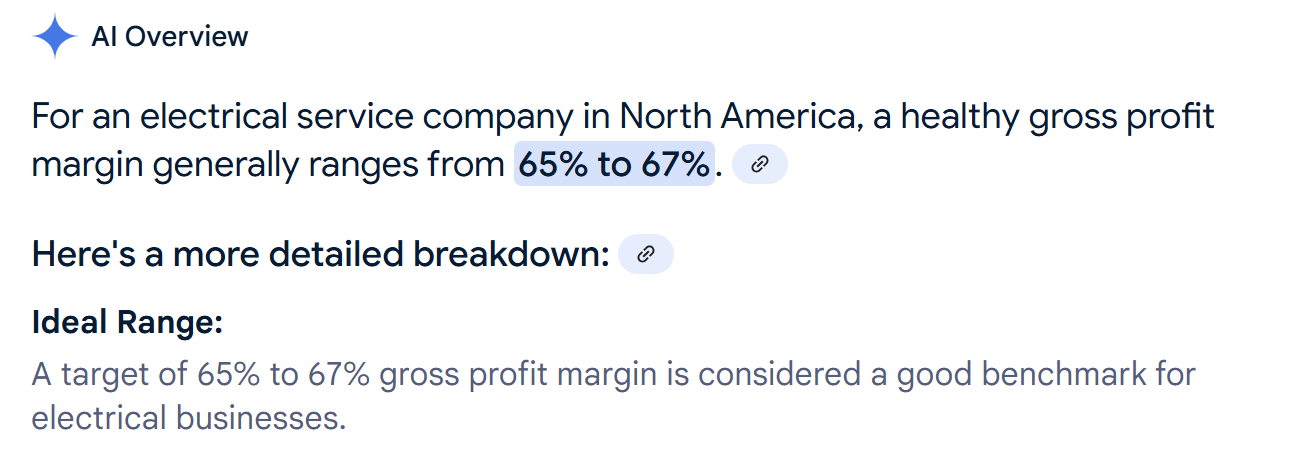
Once again we can refer to Google AI to help us. And we can see that a profit margin of 65% to 67% is what we need to charge. And this might alarm you, but its true, accept it. We need to charge in this range because of how hard running electrical service business is. Think about it; we need to do lots of marketing, some calls may be just quotes for stuff the customer is never going to hire us for, some jobs are small like resetting a circuit breaker, some are bigger but we pay for the marketing nonetheless. We have lots of different products and are likely to have warranty calls for it, sometimes people don't pay, we need to make multiple trips to simple jobs, scheduling is a nightmare, and on and on I can go.
Adding profit margin to our hourly rate
We are almost there, just have to add the profit margin and we are done. Profit margin is a little more complicated then you might think don't confuse profit margin with markup. Use a tool like Omni Calculator

There we have it! Exactly how much we need to charge for our electrical business.
Total Billable Hourly Rate: $532.40/hr
I know it already, this is going to blow your freaking mind. You've seen or heard that most guys are charging around $100/hr and here we are over 5x that, there's no way! Imma let you in on a couple secrets:
THOESE GUYS ARE BROKE! DONT COPY LOOSERS.
We calculated this using math and facts. Now man up and accept it.
Which leaves us with one challenge, how do we actually charge these prices? If you try to charge time and material at $532.40 per hour you'd get chased out of town. But I'm here to tell you there is a way.
6. How Do I Charge These Prices?
As we mentioned above, there is no way we can charge $532.40 per hour (which is why T&M doesn't work) so how do we do it? Simple, we use a Flat Rate Price Book.
A flat rate price book unlocks your business, theres more benefits then I can fit in this article but simply put a price book allows us to charge per task we do rather then hour we spend.
A good Price Book takes years to make but don't worry, I've already made one for my business, and have made it available to you (tons of electrical businesses are already using it). So if you want to shortcut years of work and hit the ground running by charging the right prices get yourself the Price Book Today! (click the link)
Hourly Rate Calculation Checklist:
Here is a quick checklist to make sure you calculate your hourly rate correctly. Remember imperfect action beats inaction, get started.

The information contained within this website is the property of electrician-academy.co. Any use of the images, content, or ideas expressed herein without the express written consent of ElectricianAcademy.co is prohibited.
Copyright © 2026 West Copper Electric, LTD. All Rights Reserved


